10 Best Brass Parts Manufacturers for Global Buyers?
Choosing reliable Brass Parts manufacturers is not a simple catalog exercise. Global buyers must examine material quality, machining accuracy, production capacity, and communication standards. A brass fitting may look perfect under showroom lights, yet fail after repeated pressure cycles or exposure to moisture.
This guide reviews ten manufacturers serving international markets. It considers alloy control, forging, CNC machining, casting, surface finishing, inspection systems, and export experience. ISO certifications can help, but certificates alone do not prove consistent production. Factory audits, sample testing, and clear drawings remain essential.
“Reliable brass production begins with process control, not attractive samples,” says Daniel Mercer, an independent brass manufacturing consultant with more than two decades of sourcing experience. His observation deserves attention. Some suppliers promise tight tolerances but provide limited inspection evidence. Others offer low prices while hiding tooling fees, packaging weaknesses, or uncertain delivery schedules.
Small details matter. Check thread gauges. Review inspection reports. Ask how rejected parts are handled.
The strongest manufacturers usually explain their limitations openly. That honesty is valuable, although it can make comparisons less comfortable. Buyers should also consider alloy traceability, RoHS or REACH compliance where applicable, packaging for sea transport, and after-sales support. Requirements vary by application and destination, so no single supplier fits every project.
This comparison is designed to help procurement teams ask better questions. It does not replace independent due diligence. A promising factory still needs practical verification before a long-term order begins.
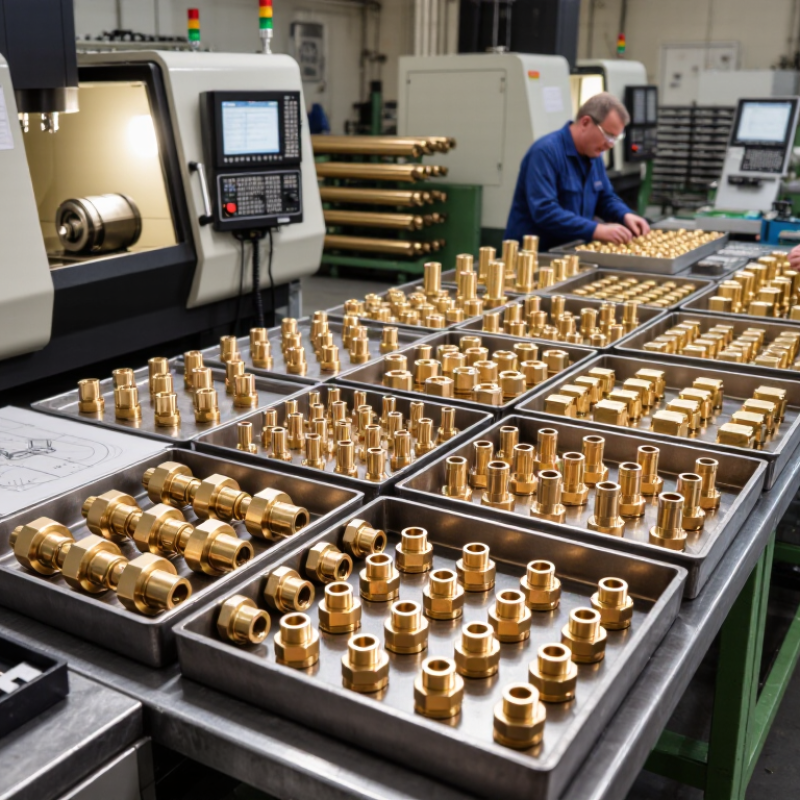
What Defines a Reliable Brass Parts Manufacturer?
What Defines a Reliable Brass Parts Manufacturer?
A reliable brass parts manufacturer proves consistency before promising volume. In practical sourcing, I look for stable dimensions, clean threads, controlled surface finishes, and repeatable delivery. A first sample may look excellent, yet production batches can expose weak process controls. This is where inspection records matter. Coordinate measuring machines, material certificates, hardness checks, and statistical process control provide stronger evidence than polished brochures.
Material traceability also deserves attention. The USGS Mineral Commodity Summaries 2024 reported about 22 million metric tons of mined copper production worldwide in 2023. That scale makes documented sourcing essential. A dependable supplier should identify alloy grades, batch numbers, recycled content, and heat-treatment details when required.
ISO 9001 certification
helps, but the ISO Survey 2022 recorded 1,265,216 certificates globally. Certification is common. It is not proof of perfect execution.
Tips: Request a recent inspection report, not a template. Compare sample measurements with drawing tolerances. Ask how nonconforming parts are isolated. Check packaging with real parts, especially for plated surfaces and fine threads. Communication speed matters too, but accuracy matters more. One uncomfortable question can reveal weak systems: What happens when your process fails?
A credible manufacturer answers with data, corrective actions, and ownership. Some buyers still overvalue low prices. That mistake can become expensive.
Key Criteria for Comparing Global Brass Parts Suppliers
When comparing global brass parts suppliers, start with evidence, not polished catalogs. Ask for alloy certificates, heat numbers, and inspection records tied to each shipment. Brass composition affects strength, corrosion resistance, machining behavior, and color. A supplier should identify copper, zinc, lead, and other elements clearly. The USGS Mineral Commodity Summaries 2024 reported that recycled copper supplied about 30% of U.S. apparent consumption in 2023. Therefore, buyers should verify recycled content and its effect on consistency. A clean certificate is useful. A traceable certificate is better.
Dimensional control deserves equal attention. Request sample reports showing thread gauges, surface roughness, coating thickness, and tolerance results. Compare measuring equipment, calibration dates, and inspection frequency. The ISO Survey 2022 recorded more than 1.2 million ISO 9001 certificates across 189 countries and economies. Certification helps, but it does not replace an on-site audit. Check production capacity against your forecast, including peak-month output and backup machinery. Ask how rejected parts are isolated, labeled, and corrected.
Logistics can quietly damage a good supplier relationship. Review export packaging, moisture protection, delivery history, and document accuracy. Under UN Comtrade classifications, brass products may appear across several copper-alloy product categories, so trade data requires careful interpretation. Compare suppliers using the same drawing, alloy grade, annual volume, and delivery terms. A low unit price may hide tooling charges, excess scrap, or expensive rework. I have found that a small pilot order often reveals more than a long presentation. It can also expose weaknesses you did not expect.
10 Best Brass Parts Manufacturers for Global Buyers? - Key Criteria for Comparing Global Brass Parts Suppliers
| Rank |
Anonymous Supplier Profile |
Primary Production Region |
Core Manufacturing Processes |
Typical Brass Alloys |
Typical Dimensional Tolerance |
Typical MOQ |
Prototype Lead Time |
Mass-Production Lead Time |
Quality System |
Export Readiness |
Buyer-Fit Score |
| 1 |
Profile A |
East Asia |
CNC turning, CNC milling, forging, die casting |
C36000, C37700, C46400, C69300 |
±0.01–0.05 mm |
50–500 pcs |
7–14 days |
20–35 days |
ISO 9001; inspection records available |
High |
9.2/10 |
| 2 |
Profile B |
Central Europe |
Hot forging, precision turning, threading, assembly |
CW614N, CW617N, CW602N |
±0.02–0.06 mm |
100–1,000 pcs |
10–18 days |
30–45 days |
ISO 9001; PPAP support |
High |
9.0/10 |
| 3 |
Profile C |
South Asia |
Investment casting, sand casting, CNC machining |
C83600, C84400, C85700 |
±0.05–0.15 mm |
100–2,000 pcs |
14–21 days |
35–55 days |
ISO 9001; material certificates |
Medium–High |
8.7/10 |
| 4 |
Profile D |
Southeast Asia |
CNC turning, cold heading, knurling, plating |
C36000, C46400, C48500 |
±0.02–0.08 mm |
500–5,000 pcs |
10–20 days |
25–45 days |
ISO 9001; final inspection |
High |
8.5/10 |
| 5 |
Profile E |
North America |
CNC machining, extrusion, stamping, sub-assembly |
C36000, C46400, C65500 |
±0.01–0.05 mm |
25–500 pcs |
7–15 days |
25–40 days |
ISO 9001; AS9100 or IATF support may apply |
High |
8.4/10 |
| 6 |
Profile F |
Western Europe |
Precision machining, forging, surface finishing |
CW508L, CW614N, CW617N |
±0.01–0.04 mm |
50–1,000 pcs |
14–21 days |
35–60 days |
ISO 9001; traceability available |
High |
8.3/10 |
| 7 |
Profile G |
East Asia |
Gravity die casting, machining, polishing, plating |
C84400, C85800, C86500 |
±0.05–0.12 mm |
200–3,000 pcs |
12–24 days |
30–50 days |
ISO 9001; coating inspection |
Medium–High |
8.1/10 |
| 8 |
Profile H |
Eastern Europe |
Bar turning, milling, tapping, heat treatment |
CW614N, CW617N, CW510L |
±0.02–0.07 mm |
100–1,500 pcs |
12–20 days |
30–50 days |
ISO 9001; batch traceability |
Medium–High |
7.9/10 |
| 9 |
Profile I |
Middle East |
Sand casting, machining, drilling, assembly |
C83600, C84400, C85200 |
±0.08–0.20 mm |
250–5,000 pcs |
18–28 days |
40–65 days |
ISO 9001; basic inspection reports |
Medium |
7.6/10 |
| 10 |
Profile J |
Latin America |
CNC machining, extrusion cutting, stamping |
C36000, C38500, C46400 |
±0.03–0.10 mm |
100–2,500 pcs |
14–25 days |
35–60 days |
ISO 9001; dimensional reports |
Medium |
7.4/10 |
Comparison note: Tolerances, minimum order quantities, lead times, alloy availability, certifications, and export capabilities vary by part geometry, annual volume, finishing requirements, and inspection standards. Buyers should verify current quotations, certification validity, material certificates, sample quality, and production capacity before placing an order.
10 Leading Brass Parts Manufacturers and Their Core Strengths
Ten Leading Brass Parts Manufacturers and Their Core Strengths
Global buyers should assess ten manufacturer profiles, not rely on reputation alone. Precision CNC specialists deliver tight threads and repeatable dimensions. Hot-forging producers offer dense grain structures for valves and connectors. Cold-heading suppliers reduce waste on screws and small fasteners. Gravity-casting manufacturers suit complex, durable housings. Sand-casting workshops handle larger industrial components. Extrusion specialists produce consistent tubes, bars, and profiles.
Plumbing-focused factories often provide tested fittings and reliable sealing surfaces. Automotive suppliers emphasize fatigue resistance, traceability, and stable production. Electronics-focused manufacturers control burrs, conductivity, and surface finish. Flexible custom producers support prototypes, mixed batches, and engineering changes. These are practical strengths, but buyers should verify them with samples.
Material risk deserves attention. The U.S. Geological Survey reported about 22 million metric tons of mined copper and 12 million tons of zinc in 2023. The International Copper Study Group also tracks copper supply volatility closely. Brass pricing can therefore shift with raw-material costs. Ask for alloy certificates, dimensional inspection records, and lead-time data. ISO 9001 certification helps, but it does not replace process evidence. A polished factory tour is not enough. I would still request three consecutive production samples. Mistakes often appear after the first shipment.
10 Leading Brass Parts Manufacturing Options and Their Core Strengths
The chart compares commonly specified UNS brass alloys using representative room-temperature tensile-strength midpoints from published material-property ranges. These alloy options support different buyer priorities, including machinability, formability, corrosion resistance, and structural strength.
Values are shown in megapascals (MPa). Actual performance varies with temper, product form, heat treatment, dimensions, and applicable material standards.
How to Evaluate Quality, Certifications, and Production Capacity
When comparing ten brass parts manufacturers, quality evidence matters more than polished samples.
Ask for material certificates showing the brass grade, chemical composition, and heat number. Independent XRF testing can confirm copper, zinc, and lead levels. Inspect threads, burrs, sealing surfaces, and plating thickness under magnification. Small defects often become costly after assembly.
Certifications should match your application, not decorate a brochure.
Verify ISO 9001 certificates, issuing bodies, validity dates, and covered production sites. Automotive buyers may require IATF 16949, while environmental requirements may involve RoHS or REACH records. Request calibration logs, inspection plans, and recent corrective-action reports. A capable supplier can explain each document clearly.
Production capacity needs practical proof.
Review the number of forging presses, CNC machines, finishing lines, and inspection stations. Ask for monthly output by part type, not total factory volume. Confirm available capacity during peak seasons. A pilot order can reveal tooling accuracy, delivery discipline, packaging quality, and communication speed. Require capability studies for critical dimensions, including Cpk results when appropriate. A polished sample can mislead. Real production is different. No audit predicts every delay, and capacity claims may change after a large order. Keep an approved backup source and review performance after each shipment.
Choosing the Right Brass Parts Manufacturer for Your Market
Choosing the right brass parts manufacturer starts with your market, not a supplier ranking. A plumbing fitting needs different controls from an automotive connector or precision valve. Confirm the required alloy, tolerances, surface finish, pressure rating, and testing method. Then ask for material certificates, inspection records, and traceability from billet to shipment.
Raw-material planning matters. The International Copper Study Group’s 2024 market outlook projected refined copper demand growth in 2024, increasing pressure on supply and pricing. The International Energy Agency also identifies copper as a critical material for electrification. These trends can affect brass costs and lead times. A capable manufacturer should explain its pricing formula, stock policy, and response to alloy fluctuations. Hidden surprises are expensive.
Audit production evidence, not promises. Check CNC capacity, die maintenance, calibration dates, sampling plans, and rejection data. Request samples made with the same process used for mass production. Verify compliance with applicable requirements, including RoHS or REACH where relevant. ISO 9001 certification is useful, but it does not replace process audits. It is only a starting point.
Delivery capability deserves equal attention. Compare realistic lead times, packaging protection, export documents, and backup capacity. A supplier may offer excellent machining but struggle during peak demand. That weakness should be discussed openly. The best choice balances quality, communication, regional compliance, and total landed cost—not simply the lowest unit price.